A tatami is the mat you sit on. At the exhibit you can watch one being made. The drawing pulls the finished mat apart.
- Cloth border.
- 表 Omote. The woven surface.
- 床 Doko. The base.
Tatami World
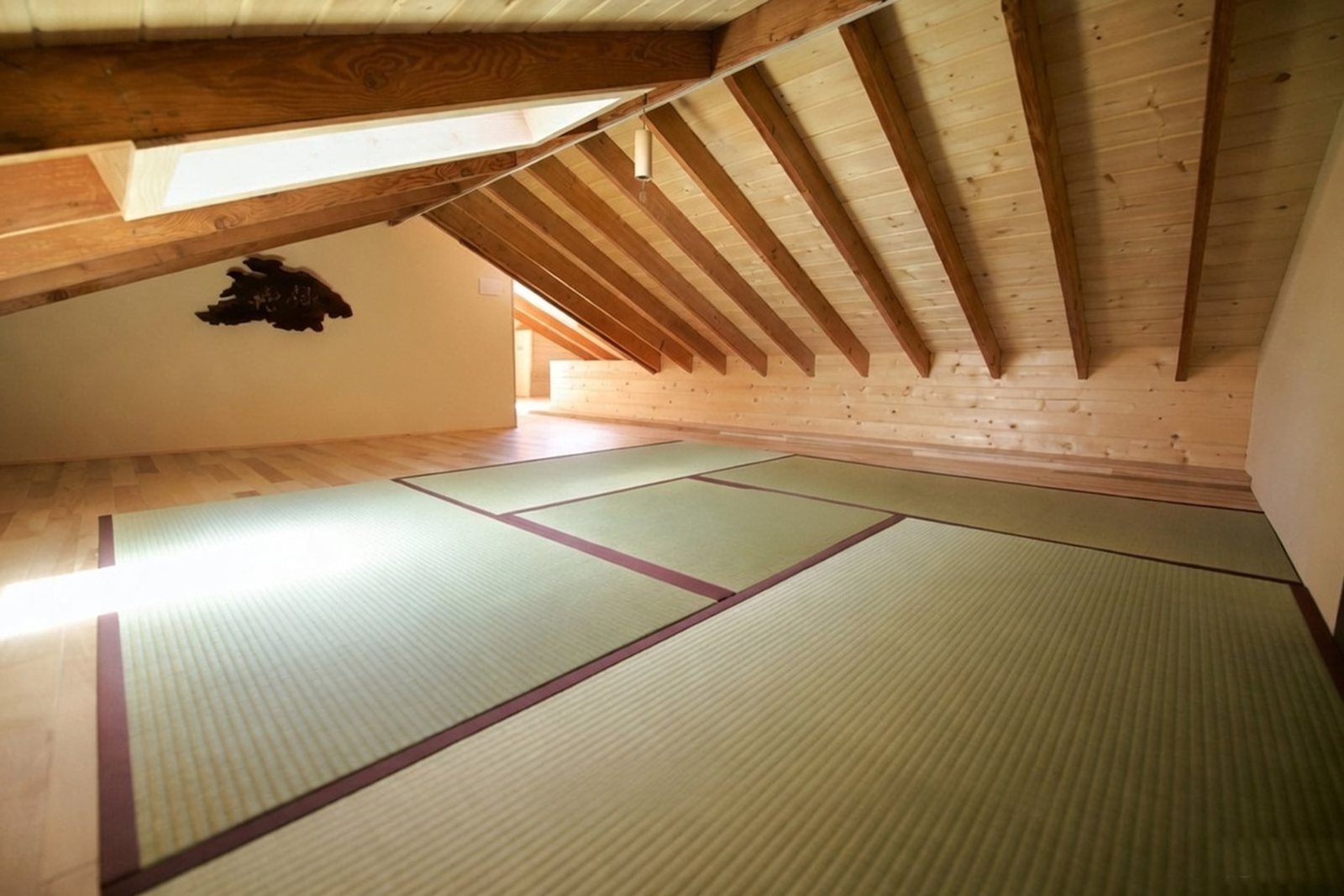
A floor of rush
Tatami has been a floor in Japan for more than a thousand years. The face is woven igusa rush. The core is traditionally rice straw. The soft face, the light scent of a new mat, and the warm color are meant to slow a room down.
A material that breathes
The rush takes in moisture when the air is damp and lets it go when the air is dry. In summer the floor feels cooler underfoot. In winter the straw core holds a little warmth. The scent stays light through the year. Daily use leaves marks. That change is part of the mat.
Made by hand in Japan
The mats are handcrafted in Japan. The rush, the straw, and the border cloth are chosen for the room, then sewn. The old construction is still the construction: a core, a woven face, and a cloth edge.
A room for now
The same mat can fill a room, sit in a corner of an apartment, or be laid for rest or tea. A thinner mat can lie on a wood floor.
Six ways to look at the same mat
Structure
Three parts
A mat is a core, a woven face, and a cloth edge. Newer cores exist. The three parts have not changed.
- 床 Toko
- The core.
- 表 Omote
- The woven face.
- 縁 Heri
- The cloth edge.
- い草 Igusa
- The rush woven into the face.
1. 床 Toko, the core
藁床 Wara-toko
The traditional core is rice straw. A stack of about 40 cm is pressed down to about 5 cm. Air in the straw takes in moisture, softens the step, and holds a little warmth. A well-kept straw core is the one that lasts.
Sandwich
Foam sits between layers of straw. The step is closer to straw than a board is, and the mat is lighter than a full straw core. It also copes better with damp. A higher sandwich uses longer straw. An ordinary sandwich uses crushed straw.
建材床 Kenzai-toko
A board core uses no straw. The usual kinds are a compressed wood-chip board, a board with a cushion layer, a board with foam, and a thin all-board core of about 15 mm. These are lighter and cost less at the start. They insulate, and they draw fewer insects. The step is firmer. Foam in the core can go flat sooner than straw.
2. 表 Omote, the face
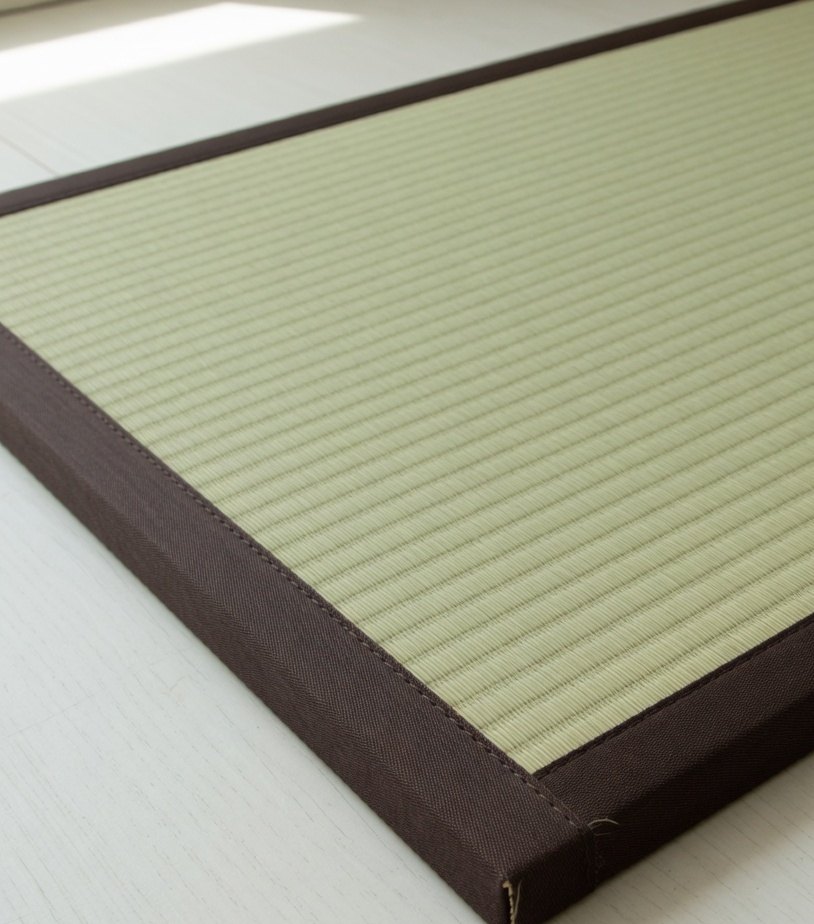
Omote is graded. The highest grade is for shrines, temples, and formal houses. It needs igusa of a set length and quality, and a strong warp. A high grade is bound with four hemp threads, two at each warp, and is often two weaves joined at the center. The igusa for that grade is cut once a year.
Houses, and orders from outside Japan, usually take a high or middle grade. It is still a careful weave, and it is easier to obtain. Lower grades have a shorter life. They suit a floor that will be resurfaced sooner. A low Japanese grade is still a different face from an imported one.
What the rush does
An igusa face softens sound, takes in and gives off moisture as the season changes, and holds a little of the room’s temperature. That is the calm people mean when they talk about a tatami room.
Japanese igusa and imported igusa
- Harvest. Imported igusa is often cut earlier. In Japan it is cut when it is mature, which is what the longer life depends on.
- Drying. Japanese igusa is dried slowly, at a lower heat, so the spring and the smooth face remain. Faster, hotter drying can take the spring out and change the feel.
- Grading. In Japan the rush is sorted at the farm for color and quality. Imported lots vary more. Some are colored, which can change the scent and the way the face ages.
Warp
Igusa is held by warp threads of hemp or cotton. A stronger warp allows a tighter weave, a thicker face, and a different step. Hemp is the stronger thread.
- Bingo, top: double hemp.
- Bingo, second: cotton and hemp. This is still above other faces.
- Yume-omote: cotton and linen.
- Asa-biki: a single hemp warp.
- Imported: double cotton, or a single cotton warp.
Other faces
Some work uses a different weave. Meseki omote is finer than a usual weave. Ryukyu omote is woven from a stronger rush, shitto-i. There are also faces of paper and of chemical fiber.
3. 縁 Heri, the border
The border was cotton or hemp. Synthetic cloth is common now. Synthetic cloth costs less and wears hard. Cotton and hemp are the finer hand and the finer look. A high grade is often hemp. The cloth may be a plain color, or a pattern, including cloth for a temple or a tokonoma.
框 Kamachi, the short end
The short ends are the kamachi. If the core is only wrapped, the corner swells and breaks. A strip is sewn in. Wood sewn by hand is the older way. It can also be sewn by machine. The strips in use are wood, plastic, and paper. Plastic is the usual strip.
Variation
Ways a mat is finished
Some mats have a cloth border. Some are made without one.
- 表 Omote
- The woven face.
- 縁 Heri
- The cloth that protects the sides and the corners.
- 琉球畳 Ryukyu
- The Okinawan mat, made without a border.
- 床の間 Tokonoma
- The alcove in a traditional room.
With a border
This is the usual mat, in houses and in temples. The border protects the corners and is also the color of the room. You choose the cloth, the color, and whether it is plain or patterned.
Without a border
Ryukyu tatami is the Okinawan mat, made without a border. A Ryukyu-style mat is a later borderless mat in that spirit. Both read as a clean floor, and the faces come in many colors. Both can be thinner than a standard mat, so they can lie on a wood floor. The work takes longer than a bordered mat, and it often costs more.
- Ryukyu omote. The traditional face of a Ryukyu mat.
- Meseki omote. A fine weave used on Ryukyu-style mats, in many colors.
Tokonoma
A tokonoma mat is made for the alcove. The traditional face is ryubin omote. A standard omote, or a thin mat (usu-datami), is also used when the room calls for it.
Portable
A portable mat is light. You set it on the floor. No fitting into a frame is required. Some are for tea. Some have an opening for a sunken hearth, an okiro. The core is a light board so the mat can be carried. The face runs from a plain grade up to Japanese igusa for tea. Enquire with the use.
Repairing
畳替え Tatami-gae
There are three ways to renew a mat. A new mat. A new face, omote-gae. The same face turned over, uragaeshi. Which one fits depends on the core, the face, and how the room is used. Enquire with what you see, and we will say which one.
- 床 Toko
- The core.
- 表 Omote
- The woven face.
- 縁 Heri
- The cloth edge.
A new mat
The whole mat is replaced. The room is measured so the new mats meet without a gap. Replace the mat when the dents are deep, when the core has lost its spring, or when insects, rot, mold, or mites have got into it. Those mats are not repaired. A straw core is often renewed on the order of twenty years, depending on the room.
表替え Omote-gae
The worn face is taken off and a new face is sewn on. Do this when the weave is scuffed through or badly waved, and the core is still sound. Depending on the grade and the room, a new face often comes about five years after an uragaeshi. If the core is damaged, replace the whole mat.
裏返し Uragaeshi
The face is woven so both sides can be used. Uragaeshi takes the face off, turns it over, and sews it back onto the same core with a new border. It is only possible while the side in use is still sound. It is often done three to five years after the mat is new.
How to choose
Face and core
Choosing a mat is two decisions. The omote, the woven face. The toko, the core. The border is chosen with them. The room, the budget, and how the floor will be used change the answer. Enquire with those three.
- 表 Omote
- The woven face.
- 床 Toko
- The core.
- 縁 Heri
- The cloth edge.
- い草 Igusa
- The rush woven into the face.
1. The face
Japanese igusa
Japanese igusa keeps its spring, lasts longer, and changes color more evenly. Grades run from an everyday weave to a fine weave.
- A living room where you want the usual look and feel.
- A room you want to age evenly.
- A floor where comfort and a long life matter.
- A tea room or a guest room.
- Premium. Guest rooms, shrines, temples, and formal houses.
- Standard. Everyday rooms, guest rooms, and bedrooms.
- Tea. Formal tea, and regular practice.
Imported igusa
Imported igusa costs less at the start. It is often cut earlier, dried faster, and graded less evenly, sometimes with color added. It can lose spring sooner, and the color can change less evenly. It suits a floor you expect to replace.
- A rental, where the mat will be changed sooner.
- A child’s room, or another floor that is walked hard.
- A job where the first cost decides it.
- A mat for a short time.
Washi and other fibers
A washi face is woven in the same way, with more colors and less scent. It fades less in the sun, marks less, and molds less. It does not have the scent of igusa, or the way igusa takes in moisture. A board-fiber face is chosen for the same reasons.
- A room you want to wipe clean.
- A sunny room, where you want less fading.
- A house that wants little scent.
- A modern room, where the color has to match.
How to look at a face
For the look, the feel, and the life of the mat, Japanese igusa is the face to start from. Then look at three things.
- Weave density. More igusa makes a tighter weave. It lasts longer, fuzzes less, and keeps an even ridge.
- The ridges. Look along the mat in a raking light. The lines should be straight and even. An even ridge feels smoother and wears more evenly.
- The warp. Hemp or cotton. Hemp is stronger and is used on the higher grades. Cotton can be strong, and it costs less, depending on the grade.
For most homes, a middle or high grade of Japanese igusa is the useful choice. It looks like tatami, it ages evenly, and it is not so fine that daily life spoils it. For a floor that is walked very hard, imported igusa is the other choice.
2. The core
藁床 Wara-toko
Rice straw takes in moisture and gives it back. Air in the straw is the cushion. Kept aired, it lasts. In a room that stays shut, it needs air, or it can mold. It costs more at the start than a board. Over the years, if the room is aired, the face is what you pay to replace.
建材床 Kenzai-toko
A board core is lighter and costs less. It insulates. The materials draw fewer mites. The step is firmer. Foam can go flat. It takes in little moisture, and mold can still appear if the room is damp.
Sandwich
Straw around a foam center. The step is closer to straw. The weight is closer to a board. The cost sits between a straw core and a board core.
The face, the core, and the border can be combined. Enquire with the room and the use.
Wara-toko
藁床 Wara-toko
Wara-toko is the straw core. Layers of rice straw are stitched, then pressed.
What the straw does
Moisture and warmth
Each straw holds air. The air takes moisture in and lets it go. In summer the floor feels cooler and drier under a bare foot. In winter the same air keeps the cold off the floor.
Spring
The straw is sewn in many stitches, then pressed, so the fibers act as one piece. It springs back, and it resists a sag. With care, the core is kept for a long time. The face is what you replace.
A plain material
The core is rice straw, with little else added. It is a quiet material for a house with children. Straw is grown again each year.
The work
A board core is cut and stacked. A straw core is stitched by hand, from loose straw to a core of even thickness. The higher cost is that time. Enquire, and we will say what the work comes to.
Grades
Grades run from premium, 特等, down through the numbered grades. A higher grade uses more straw and a closer stitch. It keeps its thickness, springs back from a dent or from the needle holes of a later re-covering, and holds the corners.
- Premium, 特等. Tea rooms, temples, and shrines.
- Grade 1, 一等. Tea rooms, and careful houses.
- Grade 2, 二等. An ordinary room.
The underside
A straw core has four backs. They differ in wear, look, and grade. A fee is not listed until it is set.
P-ura
A polyester sheet or mesh on paper. This is the usual back.
Komo-ura
A coarse mat of straw. An older back, still used in some regions.
Tanba-ura
A coarse mat of strong igusa, sewn on. It comes from the Tanba region. A higher back.
Shuro-ura
Fiber of the shuro palm. The finest back. It breathes, it stands up to damp, and it wears.
口ござ Kuchigoza
Pressing the straw leaves the ends thinner. On grade 1 and above, a kuchigoza strip is sewn across each end so the thickness stays even, and so the border threads do not pull out.
Questions
Does straw mold, or draw mites?
Straw can feed mold or mites if a room stays shut and damp. A core that has been dried in the making is less prone to this than an old, damp filling. Air the room. Keep the air from staying wet.
Why does straw cost more?
The straw is a natural material, and the stitching takes time, so the core costs more than a board at the start. The core is the part you keep. Later work is mostly a new face.
Is it cooler in summer and warmer in winter?
Yes. The air in the straw is the insulation, and it is also what moves the moisture. A board does not do this in the same way.
What about the floor under the mats?
When you enquire about a replacement, tell us about the floor underneath. Straw shows damp. Damp in the floor is worth knowing before a new core goes down.
Heri
縁 Heri, the border cloth
The border is the cloth on the long edges. Cotton, hemp, and chemical fiber are the usual cloths. Enquire for the one you want. A fee is not listed until it is set. The chips below name the color. They are not photographs of the cloth.
Cotton
Plain cotton, 100 percent cotton.
- GinkuroBlack
- GinkuriBrown
- UguisuGreen
- KinuguisuDark green
- NandoNavy
- AkachaReddish brown
- NishikichaDark brown
- NishikiaoBrown-green
Hemp
Plain hemp, 100 percent hemp. Hemp is firmer than cotton and is the cloth for a tea room. Urasenke rooms are usually black. Omotesenke rooms are usually navy.
- ShikkokuBlack
- OdoBrown
- GunjoDark navy
Hemp next to cotton
Hemp is firmer, and it is the stronger cloth. Cotton is softer in the hand. Both are for daily use.
高宮縁 Takamiya-heri
Indigo-dyed hemp, 100 percent hemp. This is the finest border.
- IndigoIndigo
Chemical fiber
A synthetic cloth, polyethylene, for colors and patterns that cotton does not have. There are many. Ask, and we will show what is on hand.
Photos

Video
Video coming.